Base Pattern vs Fashion Pattern: Understanding the Technical Foundation of Garment Design
The distinction between base patterns and fashion patterns represents one of the most fundamental concepts in technical garment construction—yet it's frequently misunderstood even by experienced sewers. Understanding this difference transforms how you approach pattern development.
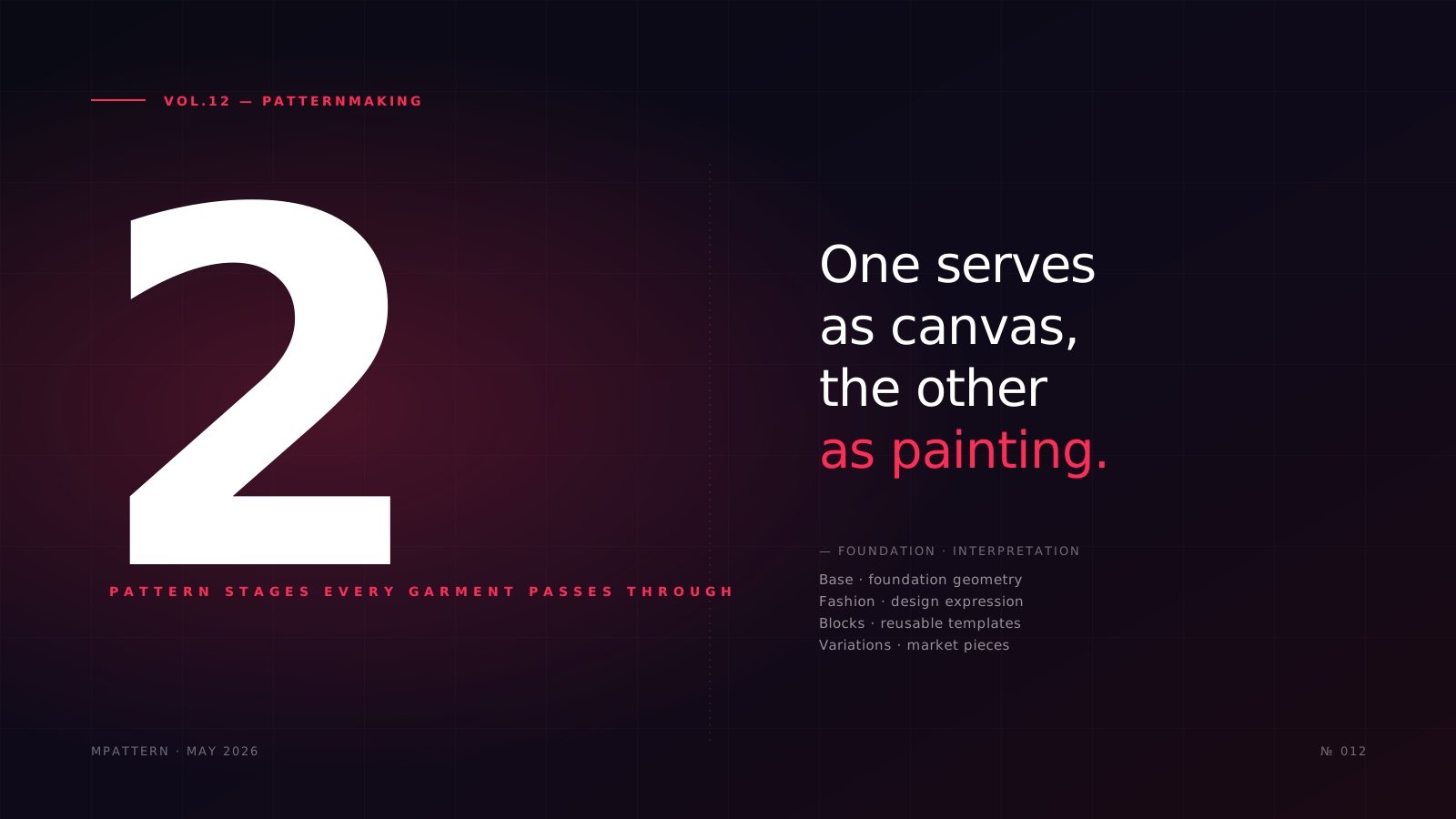
If you've ever wondered why professional pattern makers maintain libraries of seemingly identical bodice patterns, or why fashion schools spend entire semesters on what looks like the same dress form exercise, you're confronting the base pattern versus fashion pattern distinction. This isn't academic hairsplitting—it's the structural logic that separates efficient, scalable garment production from chaotic, reinvent-the-wheel approaches.
In technical terms, a base pattern (often called a block or sloper in English-speaking markets) is a fitted, dart-manipulated pattern developed from body measurements that contains no seam allowances, no style lines, and no design interpretation. It exists purely as geometric truth: the two-dimensional representation of three-dimensional body volume. A fashion pattern, conversely, is the production-ready interpretation of a specific design—complete with seam allowances, style lines, design details, and all the elements that transform abstract geometry into a market-ready garment.
The distinction matters because attempting to create fashion patterns without solid base patterns forces you to solve fit and design simultaneously—an approach that scales poorly and produces inconsistent results across size ranges.
What Defines a Base Pattern: The Geometric Foundation
A base pattern is fundamentally a fit solution, not a design. It represents the minimum number of seams and darts required to convert flat fabric into a three-dimensional form that follows body contours. For a women's bodice block, this typically means four pattern pieces: front bodice with bust dart, back bodice with shoulder dart or ease, front skirt with waist dart, back skirt with waist dart. No more, no less.
The critical characteristics that define base patterns:
- Zero seam allowance: Base patterns exist at the stitch line, not the cut line. This allows pure geometric manipulation without the confusion of added margins.
- Minimal ease: Only the wearing ease required for movement and comfort, typically 3-6 cm at bust and hip for woven fabrics. No design ease, no stylistic volume.
- Standardized dart placement: Darts positioned at conventional locations (bust apex, shoulder blade, waist) for maximum reusability across design variations.
- No style interpretation: Necklines at natural base of neck, armholes at natural armscye, waistline at natural waist. These are anatomical reference points, not fashion choices.
- Developed from measurement charts: Each base pattern corresponds to a specific size within a grading system, developed from anthropometric data or fit model measurements.
Industrial pattern development, as documented in technical papers from institutions like London College of Fashion, treats base patterns as parametric templates. Change the input measurements, and the block automatically adjusts—but its geometric relationships remain constant. This is why commercial CAD systems (and increasingly AI-powered platforms) can generate base patterns algorithmically: they're following mathematical rules, not interpreting aesthetic intent.
The bodice block you develop at 19 years old, if properly constructed, remains valid for your entire career. Fashion changes; body geometry doesn't. This permanence is why pattern makers guard their proven blocks—they represent hundreds of hours of fit refinement compressed into a reusable tool.
Fashion Patterns: Where Design Meets Production Reality
Fashion patterns are the offspring of base patterns and design sketches. They inherit the fit logic of the block but express the visual intent of the designer. This is where technical pattern making becomes interpretation: translating a two-dimensional sketch (or drape) into production-ready pattern pieces that maintain fit while achieving the desired silhouette.
The transformation from base to fashion pattern involves several distinct operations:
Dart manipulation and transfer: The bust dart in your base block might sit at the side seam—but your design sketch shows a French dart from the hip. You transfer the dart, maintaining its total angle (which represents the same amount of three-dimensional shaping) but relocating its legs to match the design.
Style line development: Your base block has a simple side seam. Your fashion design has a princess seam. You draft the princess line, then split the pattern along that line, redistributing dart volume into the shaping of the seam itself. The fit remains identical; the visual read changes completely.
Ease addition: Your base block has 4 cm of wearing ease at the bust. Your oversized coat design requires 15 cm of total ease for the silhouette. You add 11 cm of design ease, distributing it according to the intended drape and proportion.
Seam allowance addition: Base patterns have none; fashion patterns require them. Standard industrial practice is 1 cm for most seams, 3-4 cm for hems, though this varies by fabric and construction method.
Grading notation: Fashion patterns include grading rules so the style can be produced across a size range. These rules reference the base block's grade rules but may deviate where design ease or style lines require it.
According to Sourcing Journal's 2023 technical production survey, the average fashion pattern takes 6-12 hours to develop from an approved base block, depending on complexity. Without that base block? Expect 20-30 hours of iterative draping, fitting, and adjustment—and results that often still require another round of sampling.
Why the Distinction Matters: Workflow and Efficiency
Understanding the base-to-fashion pattern workflow isn't just semantic precision—it's the difference between scalable production and artisan guesswork. In commercial fashion development, this two-stage process enables:
Fit consistency across collections: Your spring collection and fall collection use different fabrics, silhouettes, and style details—but they're all developed from the same base blocks. Customers who wear your size 8 in one season can confidently order size 8 in the next.
Rapid style development: With proven base blocks, your pattern making team can focus on interpreting design without solving fit. Ateliers using standardized base blocks can significantly reduce their pattern development time compared to from-scratch approaches.
Reliable grading: Fashion patterns inherit their grading rules from base blocks. If your blocks grade accurately (proportional changes maintaining fit across sizes), your fashion patterns will too—with adjustments only for style-specific elements.
Clear division of labor: In larger production environments, junior pattern makers handle fashion pattern development from senior-approved blocks. Senior pattern makers focus on block development, fit refinement, and solving complex technical challenges. This specialization is only possible when the base/fashion distinction is clear.
The Business of Fashion has noted that brands with robust technical development processes—including well-maintained base block libraries—show 30-40% fewer fit-related sample revisions than brands using ad-hoc pattern development. Each revision costs time, materials, and schedule slippage. The upfront investment in proper base patterns pays for itself within a single collection cycle.
Common Misconceptions and Technical Clarifications
Several persistent myths muddy the base versus fashion pattern distinction:
Myth: "Base patterns are for beginners; experienced pattern makers work directly in fashion patterns."
Reality: The opposite is true. Novices often skip base pattern development because they don't yet understand its value. Experienced professionals maintain extensive block libraries because they've learned that reinventing fit geometry for every style is inefficient and error-prone.
Myth: "You only need one base pattern per garment type."
Reality: Professional pattern makers maintain multiple base blocks per garment category, each representing different fit philosophies. A close-fit bodice block, a standard-fit block, and an oversized-fit block serve different design intents. Similarly, blocks for woven fabrics differ from those for knits due to fabric behavior differences.
Myth: "Base patterns must be developed from your own measurements."
Reality: Base patterns are developed from target customer measurements, whether that's your own body, a fit model, or standardized sizing data. Personal blocks work for made-to-measure production; commercial blocks work for ready-to-wear. The logic is identical; the measurement source differs.
Myth: "Digital pattern making tools eliminate the need for base patterns."
Reality: Digital tools make base pattern development faster and more precise—they don't make it optional. Whether you're using manual drafting, commercial CAD software, or AI-powered platforms, the pattern still requires a fit-validated geometric foundation before style interpretation begins.
One particularly common confusion: thinking that purchased commercial patterns are base patterns. They're not—they're fashion patterns developed for retail, complete with seam allowances, style details, and often instructions. A base pattern is rarely something you'd purchase; it's something you develop (or have developed) to your specific measurements and fit standards.
Practical Workflow: From Block to Collection
How does this distinction play out in actual production workflow? Consider a small independent label developing a 12-piece collection:
Phase 1: Base pattern development (happens once, serves entire brand life). The designer works with a pattern maker to develop or refine base blocks for the brand's core categories: fitted bodice, fitted skirt, relaxed trouser, fitted sleeve. These blocks are fit-tested on the brand's fit model until they reliably produce the intended fit without adjustment. Time investment: 40-60 hours across two weeks. These blocks are then digitized and archived.
Phase 2: Fashion pattern development (happens per collection, per style). The designer provides sketches or drapes for the 12 collection pieces. Pattern makers use the appropriate base blocks as starting points, manipulating darts, adding style lines, integrating design ease, and developing construction details. Each fashion pattern is drafted, cut in muslin, fit-tested, and refined. Time investment: 6-8 hours per style, approximately 90 hours total across three weeks.
Phase 3: Sampling and refinement (fashion pattern adjustment). First samples reveal that Style 03's dropped shoulder needs adjustment and Style 07's side seam placement creates an unflattering drape. Pattern makers revise those specific fashion patterns. The base blocks remain unchanged—the issue was in the style interpretation, not the underlying fit geometry. Time investment: 12-15 hours across one week.
Phase 4: Grading (happens once per finalized fashion pattern). Each approved fashion pattern is graded across the brand's size range (let's say sizes 2-14). Grading rules are inherited from the base blocks but adjusted for style-specific elements (that dropped shoulder in Style 03 grades differently than a set-in sleeve would). Time investment: 2-3 hours per style, approximately 30 hours total.
Total time investment: approximately 170-175 hours across 8 weeks. Without proper base blocks? Expect 250-300 hours across 12-14 weeks, with higher risk of fit inconsistencies requiring additional sampling rounds. The efficiency gain isn't trivial—it's the difference between a sustainable production schedule and perpetual crisis mode.
Integration with Modern Digital Workflows
The base pattern versus fashion pattern distinction becomes even more critical in digital pattern development environments. Platforms built around parametric base pattern generation allow you to input measurements and fit preferences, and the system generates geometrically-sound base blocks instantly. These blocks then serve as the foundation for manual or AI-assisted fashion pattern development.
This two-stage digital workflow offers several advantages:
Version control and iteration: Your base blocks remain stable references while fashion patterns evolve through design revisions. You can explore multiple style variations from a single block without compromising your fit foundation.
Automated grading validation: Digital systems can check that fashion pattern grading rules maintain consistent relationships to base block grading, flagging potential errors before they reach sampling.
Cross-collection consistency: When all styles in your archive reference the same base blocks, you can analyze fit consistency across seasons and identify where pattern makers may have deviated from standard practices.
Reduced prototyping cycles: With algorithmically generated base patterns, your first muslin has a higher probability of requiring only minor adjustments—only style-specific refinements rather than base-level fit corrections.
The digital distinction also affects team collaboration. When your design team in Barcelona, pattern making team in Lisbon, and sampling facility in Porto all reference the same digital base blocks, communication becomes more precise. "Develop Style 12 from Block C with 8 cm positive ease" is unambiguous instruction that produces consistent results regardless of which team member executes it.
The base pattern versus fashion pattern distinction isn't pedantic terminology—it's the structural logic that enables efficient, scalable, and consistent garment production. Base patterns are your geometric foundation, developed once and refined over time. Fashion patterns are your design expression, developed per style but inheriting fit logic from those foundations. Master this distinction, and you're not just learning pattern making vocabulary—you're understanding the workflow architecture that separates professional production from perpetual improvisation.
Whether you're developing made-to-measure pieces for private clients or commercial collections for retail markets, investing in proper base pattern development pays compound returns across every subsequent fashion pattern you create. If you're looking to build that foundation efficiently, MPattern's AI-powered base pattern generation eliminates the tedious manual drafting while maintaining the technical rigor that makes blocks useful—giving you more time to focus on the creative interpretation that transforms blocks into fashion.
Frequently asked questions
Can I skip base patterns and draft fashion patterns directly from measurements?
Technically yes, but it's inefficient and error-prone. You'll be solving fit and design simultaneously, which means every new style requires full fit development from scratch. Professional workflow separates these concerns: develop proven base blocks once, then use them as reliable starting points for unlimited style variations. Direct-from-measurements approaches work for one-off custom pieces but don't scale for collections or repeated production.
How many base patterns does a professional pattern maker typically maintain?
A working professional typically maintains 15-30 base blocks covering their core categories: multiple bodice fits (close, standard, relaxed), skirt variations (straight, A-line, circle), trouser fits (slim, straight, wide), sleeve types (set-in, raglan, kimono), and dress foundations. Each block may exist in versions for wovens versus knits. Larger production houses often maintain 50-100+ blocks across their full product range, organized by fit philosophy and target customer segment.
What's the difference between a base pattern and a sloper?
They're the same thing—regional terminology differences. 'Sloper' is common in North American fashion education and industry. 'Block' or 'base pattern' is standard in European and UK contexts. All refer to the fitted, dart-manipulated pattern without seam allowances used as the foundation for fashion pattern development. Some North American sources distinguish 'sloper' as the initial drafted pattern and 'block' as the fit-tested, finalized version, but this isn't universal usage.
How long does it take to develop a reliable base pattern from scratch?
Manual development of a single bodice block—from drafting through multiple muslin fittings to final refinement—typically requires 8-12 hours for an experienced pattern maker, spread across multiple fitting sessions to allow for muslin construction between iterations. A complete foundational set (bodice, skirt, sleeve, trouser) might take 30-40 hours. Digital parametric systems like MPattern reduce this to minutes for initial generation, though fit validation still requires physical sampling.
Why do my fashion patterns not fit even though I used a base pattern?
Most likely the style changes you made disrupted the fit logic of the base block. Common culprits: adding ease unevenly (too much in one area, not enough in another), moving darts without maintaining their total angle, or changing seam angles without compensating elsewhere in the pattern. The base block provides fit geometry, but fashion pattern development requires understanding how your style modifications affect that geometry. Each dart moved, seam curved, or ease added must maintain the overall balance the block established.
With MPattern
Build your own base blocks
The parametric engine constructs technical patterns from your measurements. Auto-grading and export in minutes.
Try the engine