Sewing Robotics and Sewbots: State of Automation in Apparel Manufacturing 2026
The promise of fully automated garment assembly has captivated the apparel industry for decades. In 2026, sewbots remain a frontier technology—technically impressive yet commercially constrained. This article examines the engineering reality behind robotic sewing systems.
The apparel industry has chased the dream of automated sewing since the 1980s. Unlike automotive or electronics manufacturing—where robotic assembly lines became standard decades ago—garment construction remains overwhelmingly manual. The reason is deceptively simple: fabric is limp, anisotropic, and unpredictable. A cotton knit behaves nothing like a silk charmeuse mid-stitch, and both deform under tension in ways that confound rigid robotic grippers.
In 2026, the conversation around sewing robotics centers on incremental progress rather than revolutionary deployment. Companies like SoftWear Automation (USA), Sewbo (dissolved 2022 but influential), and newer entrants in China and Germany have demonstrated prototype systems capable of assembling basic garments—T-shirts, towels, simple wovens. Yet these machines occupy a narrow technical niche, far from replacing the estimated 60 million garment workers worldwide. According to McKinsey's 2024 Apparel CPO Survey, fewer than 2% of global cut-and-sew operations employ any robotic stitching, and most of those installations handle non-apparel textiles like automotive upholstery or technical fabrics.
This article dissects the engineering challenges, current capabilities, and commercial realities of sewbots as they stand in 2026. We examine why robotics succeeded in cutting and spreading but stalls at the sewing machine, and what that means for pattern development workflows in an industry still overwhelmingly human-driven.
The Core Engineering Problem: Fabric Compliance
Robotic arms excel at manipulating rigid or semi-rigid parts. A car door panel, a smartphone chassis, even a leather belt—these materials maintain predictable geometry under handling. Woven and knit fabrics do not. The material science term is "compliant": fabric drapes, stretches, compresses, and shifts in response to minimal force. A robotic gripper applying 2 Newtons of pressure can pucker a silk organza beyond recovery, while the same force barely moves a denim twill.
Early sewbot prototypes (circa 2015-2018) approached this by rigidizing fabric temporarily. Sewbo's dissolved polymer stiffening system—dipping fabric in a water-soluble thermoplastic, sewing the rigid result, then washing out the stiffener—proved the concept but died commercially due to added process steps, chemical costs, and incompatibility with most fashion fabrics. SoftWear Automation took a different path: machine vision and real-time feedback. Their Sewbots use arrays of cameras (up to 12 per workstation) tracking fabric edges at sub-millimeter precision, with servo-driven clamps repositioning material mid-seam.
The vision approach works for high-contrast, stable materials. A white T-shirt blank on a dark conveyor, pre-cut with laser precision, can be grabbed, aligned, and fed through an industrial single-needle lockstitch head. But introduce a print with low-contrast seam allowances, a fabric with significant stretch recovery, or a design requiring eased curves (like a set-in sleeve), and error rates spike. Data from Just-Style's 2025 automation report indicates current sewbot systems achieve 92-96% first-pass yield on basic rectangular seams (towel hems, pillowcase edges) but drop to 60-75% on curved seams with ease, making them economically unviable for anything beyond the simplest geometries.
SoftWear Automation: Technical Deep Dive
SoftWear Automation, founded in 2007 out of Georgia Tech research, remains the most visible sewbot developer in the Western market. Their flagship product, the Sewbot workstation, automates T-shirt assembly from pre-cut fabric panels. The system integrates:
- Vision modules: stereo cameras with structured light projection, running proprietary edge-detection algorithms at 120 fps to track fabric position within ±0.5mm tolerance.
- Handling system: vacuum grippers and servo-actuated clamps that lift, rotate, and align fabric panels. Grippers use porous sintered metal tips to distribute suction evenly, minimizing fabric distortion.
- Sewing head: a modified Juki DDL-series industrial lockstitch machine, with motor control synchronized to fabric feed rate. The machine doesn't "innovate" stitching—it uses proven 1960s stitch formation tech—but coordinates it with robotic handling.
- Process control: a PLC (programmable logic controller) running real-time Linux, managing the sequence: grab panel A, align with panel B, feed to needle, monitor thread tension via load cell, adjust speed if resistance detected.
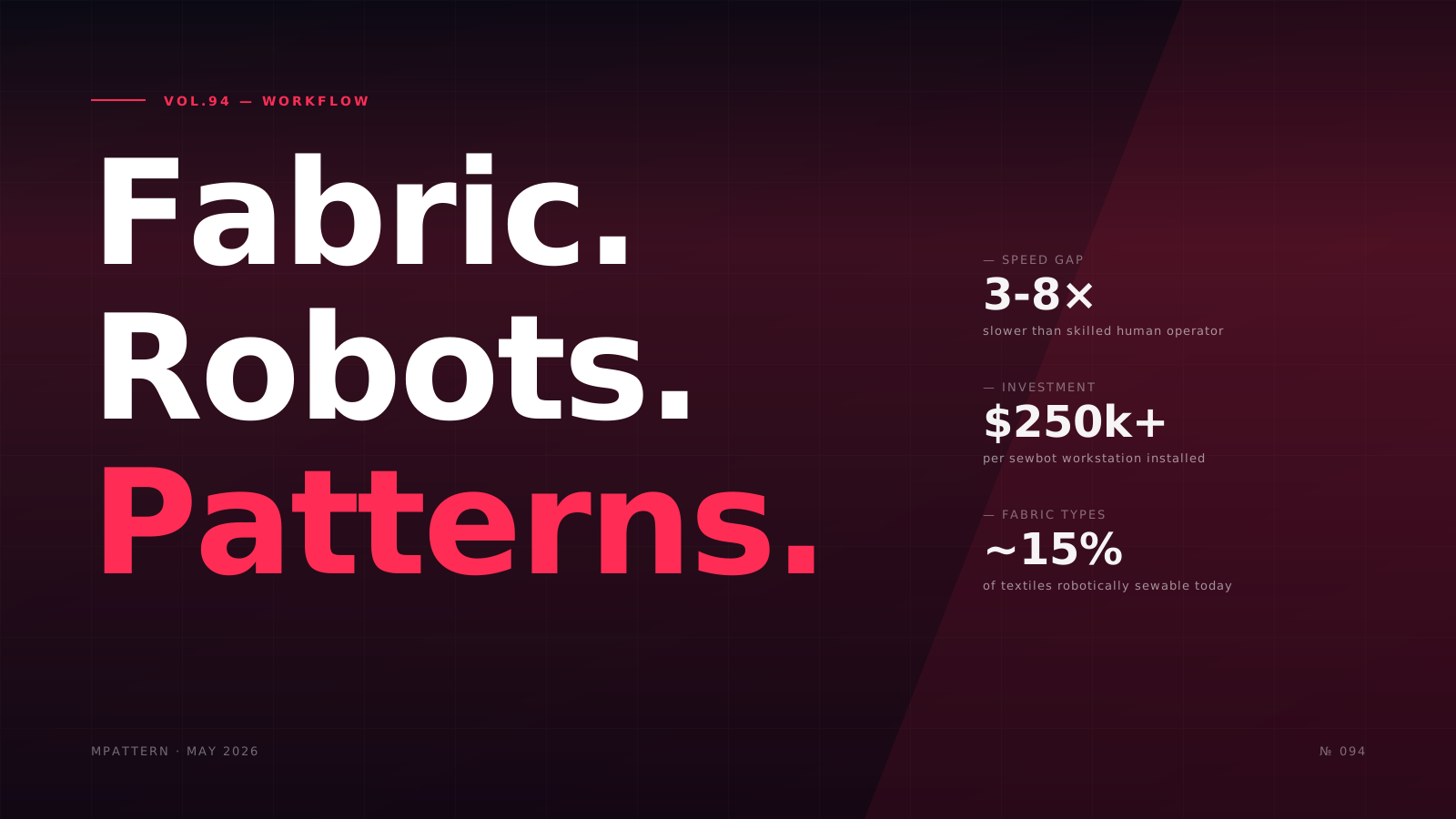
A complete Sewbot line for basic T-shirts occupies roughly 80 square meters and requires one human operator to load cut panels and clear finished goods. SoftWear claims throughput of 1,200 units per 8-hour shift for a single-style run—impressive compared to zero, but a skilled team of four sewers can produce 1,800-2,200 units in the same timeframe with faster changeover between styles. The capital cost differential is stark: a sewbot line runs $800k-1.2M installed, while four industrial sewing machines and tables cost under $15k.
The economics only pencil out in specific scenarios: ultra-high-volume single-SKU production (military undershirts, institutional uniforms), near-shoring plays where labor cost differentials justify automation (USA domestic production competing with imports), or technical applications where precision stitching (±0.3mm seam straightness) commands a premium.
Why Robotics Struggles Where Humans Excel
A human sewing operator performs continuous micro-adjustments that current robotics cannot replicate economically. Consider a simple curved seam joining two pattern pieces with different bias orientations. The operator:
- Pre-tensions the top layer slightly, knowing the feed dogs will pull the bottom layer faster due to fabric nap direction.
- Eases the longer edge into the shorter by distributing fullness across 20-30cm, using fingertip pressure to guide—not force—the fabric.
- Compensates for thread tension fluctuations by adjusting hand speed mid-seam, preventing puckers without touching the machine's tension dial.
- Detects anomalies (a thick seam intersection, a slub in the yarn) and preemptively adjusts needle penetration force to avoid thread breaks.
This sensorimotor intelligence operates at 200-300 milliseconds response time, driven by tactile feedback and pattern recognition honed over thousands of seams. Replicating it robotically demands:
- Force sensors at gripper contact points (adds $8k-12k per gripper assembly).
- Adaptive control algorithms that learn fabric-specific behaviors (requires training datasets of 10,000+ seam variations per fabric type).
- High-speed actuation matching human hand repositioning speed (current servo systems lag by 3-5× in acceleration).
The R&D cost to generalize these capabilities across the 200+ fabric types in a typical fashion brand's seasonal collection is prohibitive. According to Sourcing Journal's 2024 technology survey, even brands investing heavily in automation (Nike, Adidas, VF Corp) limit sewbot trials to 1-3 standardized fabric constructs, running parallel manual lines for everything else.
Current Adoption Landscape: Niches and Limitations
As of early 2026, robotic sewing installations cluster in predictable segments:
Technical textiles: automotive seating, aerospace composites, medical drapes. These applications tolerate the high capital cost because they value precision (airbag seams must hit ±0.2mm tolerances) and work with stable, homogeneous materials.
Promotional apparel: blank T-shirts, tote bags, simple caps. High-volume, single-design runs where the per-unit cost amortizes the setup time. A sewbot line running 24/7 on one SKU for 90 days becomes competitive with offshore labor.
Pilot programs: Fashion brands testing "Made in USA/EU" feasibility with robotic micro-factories. These rarely scale beyond PR value—Adidas famously shuttered its German Speedfactory (robotic knitting + assembly) in 2019 after determining it couldn't match Asian factory economics even with zero labor cost.
Defense contracts: military uniforms where domestic sourcing mandates override cost concerns. The U.S. Defense Logistics Agency trialed SoftWear systems for PT shirts in 2021-2023; results remain classified but anecdotal reports suggest the program continues at limited scale.
Notably absent: fast fashion, luxury, and anything requiring style variation. A Zara-style production model with 500+ new styles weekly and lot sizes of 300-1,200 units cannot absorb sewbot changeover times (4-12 hours to reprogram and test a new seam sequence) or tolerate the rigidity of pre-cut panels optimized for robotic handling.
The Pattern Developer's Perspective: Designing for Robots
If sewbots gain traction, pattern engineering must adapt—not just digitizing existing drafts, but rethinking garment architecture for robotic assembly constraints.
Seam hierarchy: Robots handle straight seams and gentle curves well, struggle with compound curves and three-dimensional shaping. A traditional shirt yoke—curved at the shoulder, eased into the back panel—would need re-engineering as two or more straight seams with separate pressing steps.
Piece count optimization: Fewer pieces mean fewer pick-and-place operations. A four-panel T-shirt (front, back, two sleeves) is sewbot-friendly. A 22-piece tailored jacket is not. This inverts traditional patternmaking logic, where more pieces often improve fit and reduce fabric waste through nesting.
Seam allowance standardization: Robotic vision systems perform best with uniform allowances (e.g., 10mm throughout). Human sewers routinely work with variable allowances (6mm at necklines, 15mm at side seams) to balance bulk and strength. Patterns destined for sewbots need geometric consistency that may compromise fit subtlety.
Grain precision: A 2-degree off-grain cut piece causes a human sewer zero trouble—they compensate instinctively. A sewbot, expecting the fabric edge at a programmed angle, will misalign the seam. This demands tighter cutting tolerances (±0.5mm, ±0.3° rotation) that strain even advanced automated cutters.
For designers working in platforms like MPattern, this means maintaining two pattern versions if hybrid production is in play: a "human-optimized" draft prioritizing fit and fabric utilization, and a "robot-compatible" variant trading some fit nuance for geometric simplicity. The workflow overhead is non-trivial, and most small-to-midsize brands don't have the engineering staff to manage dual pattern libraries.
The AI Angle: Where Machine Learning Actually Helps
Sewing robotics vendors frequently invoke "AI" in marketing materials, but the meaningful applications are narrow and specific.
Defect detection: Convolutional neural networks trained on images of correct vs. defective seams (puckers, skipped stitches, tension irregularities) can flag errors faster than human QC, with 94-97% accuracy reported in academic studies (e.g., Zhang et al., Textile Research Journal 2023). This doesn't automate sewing itself but reduces post-sewing inspection labor.
Fabric behavior prediction: Machine learning models correlate fabric mechanical properties (tensile strength, elongation, bending rigidity measured via Kawabata KES systems) with optimal sewing parameters (needle size, thread tension, stitch density). A 2024 study from North Carolina State's Wilson College of Textiles demonstrated 12% reduction in setup time for new fabrics using ML-guided parameter selection. Real-world adoption remains limited—most factories rely on operator experience.
Path planning: For robotic grippers navigating around a fabric panel to align seams, reinforcement learning algorithms can optimize movement sequences, shaving 1.5-3 seconds per pick-place cycle. Over 10,000 cycles/day, this compounds to measurable throughput gains.
What AI does NOT do (despite vendor claims): generalize across arbitrary fabric types without retraining, replicate human intuition about ease and drape, or eliminate the need for rigid process control. The sewbot software stack is overwhelmingly classical control theory—PID loops, state machines, computer vision thresholding—with ML as a minor optimization layer.
Economics: The Brutal Math of Automation ROI
Let's model a base case: a contract manufacturer in Arkansas considering sewbots to compete with Bangladeshi imports on basic T-shirts.
Capital: $1M for a 3-unit sewbot line (assembly only; cutting/finishing separate). Financed at 6% over 7 years = $174k/year.
Labor: 2 operators at $18/hour loaded = $75k/year. Maintenance tech 0.5 FTE = $35k/year. Total $110k/year.
Throughput: 4,000 units/day/line at 90% uptime = 1.08M units/year.
Per-unit cost: ($174k + $110k + $50k consumables) / 1.08M = $0.31/unit (assembly only).
Meanwhile, a Bangladeshi factory with 30 sewers producing the same T-shirt at $2.20/hour loaded labor yields $0.18/unit assembly cost (assuming 50 units/operator/day). Add $0.10 freight, $0.05 duty, $0.03 compliance overhead = $0.36 landed cost—barely more than the domestic robot.
But the comparison misses critical factors:
- The robot line handles ONE style efficiently. Style changeover costs 8 hours downtime + engineering time. The manual line switches styles in 30 minutes.
- Fabric defects that a human sewer routes around (sewing 2cm off the flaw) stop a sewbot, requiring operator intervention or scrapping the piece.
- The robot's $0.31 excludes cutting and finishing, which still require human labor (adding $0.15-0.20/unit). Total domestic cost: $0.46-0.51 vs. $0.36 import.
The economic case closes only if:
- Tariffs or trade policy shift 15%+ in favor of domestic production.
- Lead time advantage (2 weeks vs. 12 weeks from Asia) commands premium wholesale pricing.
- Volume sustains 24/7 operation on a single SKU for months.
Few fashion contexts meet all three conditions.
What 2026 Looks Like in Practice
Touring industry trade shows (Texprocess, ITMA, Sourcing at MAGIC), the 2026 sewbot narrative is one of tempered expectations. Vendors no longer promise "lights-out factories" or "the end of offshore manufacturing." Instead, they position robotic sewing as a tool for specific hybrid workflows:
- Micro-factories co-located with retail (Uniqlo's Tokyo prototype, H&M's Stockholm trial) sewing custom-fit basics on-demand. Limited SKU range, premium pricing, brand storytelling value outweighs cost.
- Reshoring of commodity items where geopolitical risk (supply chain disruption, human rights concerns in certain regions) justifies paying a 20-30% cost premium for domestic sourcing.
- Technical performance wear where precision stitching (welded seams on waterproof shells, flat-locked athletic seams) benefits from robotic repeatability.
For the mainstream fashion industry—brands producing 50-500 styles per season in lots of 500-5,000 units—manual sewing remains the baseline, with automation limited to upstream (cutting, spreading, marking) and downstream (pressing, folding, packaging) processes where materials are more predictable.
Implications for Pattern Development Workflows
Designers and pattern makers navigating this landscape in 2026 should maintain strategic flexibility:
Modular pattern architecture: Draft patterns as composable blocks (bodice front, sleeve, collar) that can be combined for human production or simplified/merged for potential robotic runs. Digital tools—including parametric systems offered by platforms like MPattern—make maintaining pattern variants less onerous than in the paper era, but discipline is required to keep libraries coherent.
Specification rigor: If any portion of production might touch a sewbot, seam allowances, grain lines, and notch positions must be specified to ±1mm—not the ±3mm tolerance typical of manual production. This precision pays dividends in cutting accuracy and QC even for human sewing.
Fabric selection awareness: Engage with fabric suppliers early to understand drape, recovery, and surface consistency. A fabric that "sews beautifully" by hand may have tension characteristics that confound robotic handling. Testing swatches under standardized conditions (tensile, bending, shear per ASTM D1388, D4964 protocols) provides data to inform both human and robotic process planning.
Style-volume segmentation: Identify which designs suit high-volume, low-variation production (candidates for automation) vs. which demand craft flexibility (stay manual). A brand's core basic tee might justify robotic investment if annual volume exceeds 500k units; seasonal fashion pieces at 2k units/style never will.
The pattern developer's role expands from pure creative/technical drafting to include manufacturing strategy—understanding when geometric simplicity enables cost savings, and when it sacrifices the design intent that differentiates the brand.
Conclusion: Evolution, Not Revolution
Sewing robotics in 2026 remains a technology in search of its optimal application domain. The engineering is sound—machines can absolutely sew fabric, with precision exceeding human capability on controlled tasks. But the economic and operational context of apparel manufacturing—high style variation, diverse material behaviors, distributed global supply chains optimized over decades—does not yet favor wholesale automation.
For pattern makers and designers, the practical takeaway is readiness without disruption. Develop digital fluency, maintain geometric rigor in your drafts, and understand the constraints that would make a pattern "robot-ready"—but don't abandon the fit subtleties and creative freedom that manual sewing enables. The industry will automate incrementally, in niches where volume and simplicity align. The bulk of garment construction will remain human-driven for the foreseeable decade.
If you're building pattern libraries that need to flex between production methods—or simply want the precision and version control that anticipates future manufacturing evolution—explore how MPattern's digital tools support rigorous, adaptable pattern development without locking you into any single production paradigm.
Frequently asked questions
Can sewbots handle stretchy knit fabrics like jersey or rib?
Current sewbot systems struggle with knits that have more than 20-25% stretch. The fabric deforms unpredictably under gripper pressure and feed dog contact, causing misalignment and puckering. Most successful robotic sewing installations use stable wovens or low-stretch technical knits (ponte, scuba). High-stretch fabrics like jersey require constant real-time tension adjustment that exceeds today's sensor and control capabilities at production speed.
How long does it take to program a sewbot for a new garment style?
Setup time for a simple style (T-shirt, pillowcase) ranges from 4 to 12 hours, including creating the pick-and-place sequence, teaching seam paths, calibrating vision systems for the specific fabric, and running test cycles. Complex styles with curved seams or multiple fabric layers can require 20-40 hours. This contrasts with human sewers who can switch styles in under an hour, making sewbots economical only for long production runs of thousands of identical units.
What's the difference between a sewbot and a regular automated sewing machine?
An automated sewing machine (like a programmable pocket setter or buttonholer) performs one specialized operation repeatedly but requires a human operator to load fabric, align it, and move to the next station. A sewbot integrates robotic handling—grippers, conveyors, vision systems—to pick up cut fabric pieces, position them, execute the seam, and transfer to the next step without human touch. The sewing mechanism itself is often a standard industrial machine; the robotics handle everything before and after the needle.
Are there any fashion brands successfully using sewbots at scale in 2026?
No major fashion brand operates sewbot production at scale comparable to their manual factories. Pilot programs exist—Adidas tested robotic assembly in Germany 2016-2019, some athletic brands trial it for technical seams—but these represent under 1% of output. The primary users in 2026 are contract manufacturers producing ultra-high-volume basics (plain T-shirts, institutional uniforms) or technical textiles (automotive, medical) where consistent material and single-style runs justify the capital investment. Fashion's variety and volume dynamics don't yet align with sewbot economics.
Will sewing robots eliminate garment worker jobs in developing countries?
Not in the foreseeable decade. The economic case for sewbots hinges on high labor costs (USA, Western Europe) and ultra-simple garments. In countries where sewing labor costs $2-4/hour and workers handle 30+ different styles weekly with minimal changeover, manual production remains far cheaper and more flexible. McKinsey estimates fewer than 5% of global garment sewing will be automated by 2030. Job displacement risk is higher in cutting and spreading (already heavily automated) than in sewing assembly, where human adaptability to fabric variation remains unmatched.
With MPattern
Cut without printing — projector mode
Project the pattern directly onto fabric. Zero paper, zero taping, guaranteed 1:1 scale.
Try projector modeRelated articles
Fashion tech
Best Software for Sewing with a Projector in 2026: A Technical Guide for Serious Sewists
Fashion tech
Virtual Try-On with AI: How Zara, Levi's and ASOS Are Reshaping Ecommerce Fit
Fashion tech
Computer Vision for Quality Control in Industrial Garment Manufacturing: Real-Time Defect Detection Systems